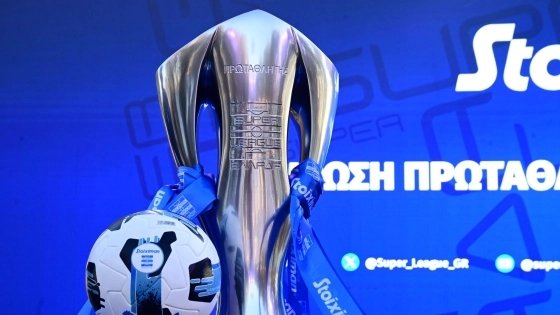
Ever since the Greek Super League implemented the play-off/play-out system from the 2019/20 season and, more recently, when the middle Europe play-offs for 5th-8th were added from 2024/25, it has received a mixed response from supporters.
In the aftermath of the 2025/26 Greek Super League season, five clubs proposed reverting the top flight to a more traditional league format. This idea was rejected after a vote from all 14 clubs and EPO (Greek Football Federation).
The decision drew mixed responses from supporters online, with some speaking positively about maintaining the play-off system. In contrast, others believed that the league needed a change and that the current format is flawed.
One thing is for certain: you can’t please everyone. This does beg the question, or questions, of what other changes Greek football fans would like to see in the domestic game, and how realistic would it be for their implementation?
The vote
With the play-offs being the current format for the last seven seasons, there have been rumours, at least since the end of 2024/25, of a potential change back to a more traditional league system.
As mentioned above, five clubs, namely PAOK, Asteras Tripolis, AEL, Panetolikos and Panserraikos, put forward the proposal to the rest of the Super League council and EPO to increase the league to 16 teams and remove the play-off format for the upcoming 2026/27 season.
Passing laws or significant regulatory changes in the Super League requires a three-quarters majority of the council, meaning 12/15 votes.
The motion was rejected, with the outcome being seven in favour (AEL, PAOK, Panserraikos, Panetolikos, Asteras Tripolis & Levadiakos, alongside EPO) and seven voting against (Panathinaikos, AEK, Aris, OFI, Volos, Kifisia & Atromitos). Olympiakos abstained from voting.
What are the arguments for and against?
Some believe that it has improved the quality of Greek clubs, particularly the smaller teams in the division, making the league overall more competitive and less predictable on a game-by-game basis.
The ‘Big Four’ have increased their revenue from playing more derby matches, with games against each other increasing to four instead of two previously, as well as an increase in ticket sales, and broadcast revenue also on the up.
An interesting argument put forward concerns Greek clubs’ performances in Europe, since the play-offs being implemented coincided with the upward trajectory of performances on the continent.
Due to more derby matches and therefore the big four competing against better quality opposition more often during a domestic season, this in turn has made Greek teams more competitive on the European stage.
Greece’s UEFA coefficient ranking has increased over the last few years from as low as 20th in 2020/21 to 11th at the end of 2025/26 and just outside of the top 10 by a miniscule 0.113 points.
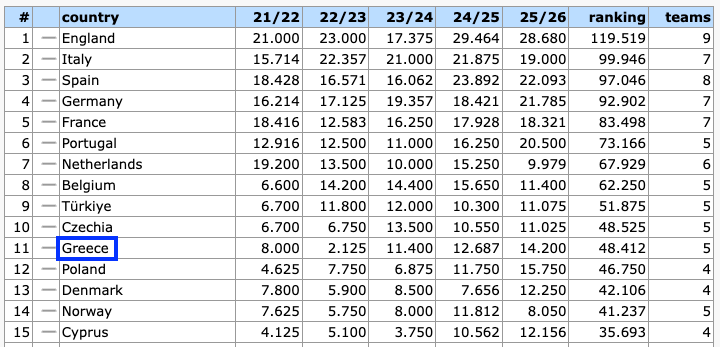
So while it is not the only reason for Greek teams doing better in UEFA competitions, some supporters see the correlation and see that as a big factor.
Also, with the improved quality of smaller clubs, there is arguably no easy fixture in the Super League anymore, even from newly-promoted clubs.
Detractors, however, see the play-offs as a model that creates a closed shop for the big clubs when the league splits after the regular season.
The claims are that it prevents mid-table teams from competing for a higher league finish in the latter stages of their campaign, pushing for the European places and disrupting the established big four.
The clubs who are too good to be relegated, both on paper and by points, end up in the play-outs and their season is essentially over with 10 games to spare.
As for derby matches, supporters feel the play-offs dilute the biggest fixtures in the Greek football calendar and make the occasions feel less special.
Regarding Super League 2 clubs, some also argue that not expanding the league from 14 back to at least 16 clubs would make it easier for more historically important clubs to return to the top flight, with the likes of group runners-up Panionios and Niki Volou both missing out on promotion last season.
There is also a suggestion that the current system creates more fixture congestion and this is a disadvantage for clubs competing in Europe, especially when you include the Greek Cup format with a league phase before the knock-outs.
A potential compromise?
In the days preceding the vote for a 16-team league, Kifisia, who, as a reminder, voted against the original proposal, put forward a different idea.
Their proposal was to expand the league from 14 to 16 teams while retaining the play-off system. The regular season would consist of 30 rounds with 16 clubs before splitting into three play-off groups.
The championship play-offs (1st-4th) would have an unchanged format from the current iteration, with six matches per team to determine the league champion.
Secondly, the European play-offs (5th-9th) would have five clubs compete for the final European place with eight matches per team. Points would be halved before the mini-league begins.
Lastly, the relegation play-offs (10th-16th) would involve seven clubs locked in a battle for survival in the top flight – six matches per team, and the bottom two would be relegated directly. The 14th-placed team would enter a two-legged playoff against the 3rd-place Super League 2 side
To facilitate the expansion, only one club would be relegated in 2025/26, while three clubs would be promoted from Super League 2.
The proposal is expected to be discussed at an upcoming Super League board meeting, so at the time of writing we do ot know the outcome of that vote.
It is an intriguing proposal, and while it will have its critics and probably its flaws, like the current system, it might favour all clubs involved.
In my humble opinion
To quickly give my personal take, I have always been an advocate to return to 16 teams and a traditional league format.
While the play-off format has its merits and at times can be exciting, the league has progressed enough since the change.
The gap between the big sides has shrunk, and the smaller teams are seemingly more financially stable, better equipped to compete and can no longer be seen as cannon fodder for the ‘Big Four’ to get an easy three points.
Only three other domestic competitions in UEFA’s top 15 leagues – the Czech First League, the Danish Superliga and the Cypriot First Division – have a play-off system.
All three are divisions of comparative size by European football standards to Greece, which currently has the smallest top-flight in UEFA’s top 12 leagues.
But I still believe that the Super League should emulate another similarly sized division, that being the Belgian Pro League.
They will be ditching their needlessly-complicated play-off format for the 2026/27 season, expanding the league to 18 teams from 16, and playing 34 matches with only two games per opponent.
There is every chance that Kifisia’s proposal gets the majority needed to implement their proposal for 2027/28.
It could be a breath of fresh air and further progress our league to new heights of excitement for fans, generate more revenue and interest for clubs and be a roaring success, and we as supporters would be very pleased to see that outcome.
With that being said, even if that does occur, I will probably still be grumbling in a kafenio somewhere – having recently turned 30 years old and verging on retirement – about how we should have a normal league system, none of this play-off nonsense, and if it ain’t broke, don’t fix it.





Leave a Reply