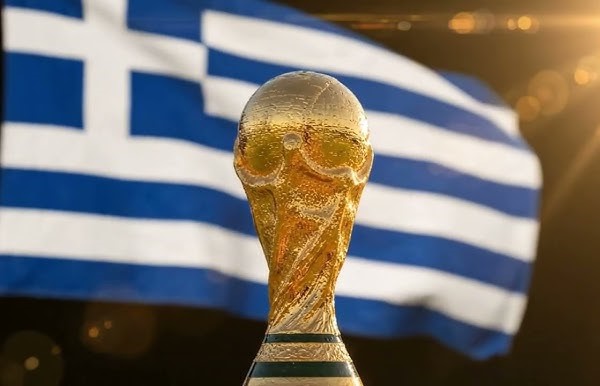
While watching the FIFA World Cup in the USA, Canada and Mexico, the thought occurred to me of how we could see our Ethniki back at a major tournament again.
Why don’t we just cut out the middleman of actually getting there via the qualifiers and say, let’s just host a major tournament instead? Simple as, right? Well, not exactly.
Since the turn of the century, Greece has been part of several joint proposals to host either the World Cup or the European Championships, but none have ever been the winning bid or progressed past a mere concept.
But what would it take for Greece to actually host a major international competition?
What are the requirements to host the World Cup?
Hosting the World Cup requires a country or group of countries to submit a formal bid to FIFA through its national football association.
The bid must include a comprehensive hosting plan that outlines how the tournament will be delivered, covering infrastructure, operations, finances, sustainability, and legacy.
Governments must also provide official guarantees for areas such as security, visa access, taxation, customs, and legal support.
A successful bid must demonstrate that the host nation has the necessary infrastructure to stage the tournament.
This includes approximately 14 compliant stadiums, with capacities of at least 40,000 seats for most matches and over 80,000 seats for the final.
The host must also provide international airports, efficient transport networks, hotels, training facilities, medical services, and reliable telecommunications to accommodate teams, officials, media, and millions of visitors.
Financial capability and government commitment are equally important.
The host country must prove it can fund infrastructure improvements, operate the tournament safely, and meet FIFA’s commercial and broadcasting requirements while delivering long-term social and economic benefits.
FIFA then evaluates each bid through technical inspections, risk assessments, and compliance reviews before selecting the host nation.
Even after all the hoops nations must jump through to host the World Cup, could Greece do so independently? The short answer is no.
As of 2026, Greece only has one stadium that exceeds a capacity of 40,000, that being OAKA (the Athens Olympic Stadium), but the country has no stadiums with the number of seats required to host a World Cup final.
If we look at the 14 current biggest stadiums in Greece in order of capacity, they are as follows:
Biggest stadiums in Greece by capacity
OAKA (Athens) – 69,618
Giorgos Karaiskis Stadium (Piraeus) – 33,339
Agia Sophia Stadium (Athens) – 32,500
Toumba Stadium (Thessaloniki) – 28,703
Kaftanzoglio Stadium (Thessaloniki) – 27,770
Pankritio Stadium (Heraklion, Crete) – 26,240
Pampeloponnisiako Stadium (Patras) – 23,588
Kleanthis Vikelidis Stadium (Thessaloniki) – 22,800
Panthessaliko Stadium (Volos) – 22,700
AEL FC Arena (Larissa) – 17,118
Leoforos Stadium (Athens) – 16,003* (soon to be demolished)
Trikala Municipal Stadium (Trikala) – 15,000
Georgios Kamaras Stadium (Athens) – 14,200
Alcazar Stadium (Larissa) – 13,108
The vast majority fall way short of the required stadium capacity and modernisation needed to bring Greece even close to being a sole host.
Panathinaikos, Olympiacos and PAOK are due to move into higher-capacity venues once construction on their respective stadia is completed.
Prasini’s Votanikos Stadium will reportedly be over 40,000; Thrylos’ new Karaiskakis Stadium will be increased to 53,000; and Dikefalos’ new Toumba Stadium will reportedly host between 33,500 and 40,000 spectators.
AEK’s new award-winning Agia Sophia Stadium, which is currently the most state-of-the-art ground, is unfortunately just short of FIFA’s requirements to host any match at a World Cup.
This means that, once all the aforementioned stadiums are built, and unless others are modernised, renovated, and their capacities increased, Greece would only have four stadiums fit for purpose, and none could host a World Cup final.
There is also the issue that the stadiums are not evenly spread throughout Greece.
Of those mentioned grounds, three are in Athens (yes, Piraeus is technically located within the greater Athens urban area), one in Thessaloniki and none anywhere else in the country.
Now there is every chance that, in theory, EPO and the Greek government could create a proposal for FIFA in which they would lay out how stadiums would be renovated and transportation would be further improved to handle the influx of football fans travelling to the country and any other boxes that need ticking to put in an official bid as a sole host.
The next opportunity for a UEFA-affiliated nation to be allowed to bid is 2042, given Spain’s heavy involvement in the 2030 tournament, which could give time to put everything into place.
But in the end, it is not realistic for a country the size of Greece to host by itself.
With the increased number of teams to 48 (potentially rising to 64), the financial pressures, a complete overhaul of building infrastructure at a national level and the aftermath of hosting – where there would be nearly a dozen 40,000-plus capacity stadiums that would struggle to be filled by club teams outside of the ‘Big Four’ and would likely be a drain on the club or public resources to maintain – Greece being sole hosts is a nice fantasy, but in reality, it makes little sense.
Could Greece co-host the World Cup?
That is why co-hosting is much more realistic.
A joint bid with one or more countries would greatly lower the many burdens that hosting the World Cup would bring, and it is a concept that has been explored before.
For both the World Cup and UEFA European Championships, Greece has been part of several bids in the past.
The first was for Euro 2008, when Greece, jointly with Turkey, attempted to co-host the tournament.
They ultimately failed, with Austria and Switzerland eventually being awarded hosting rights.
Along with Bulgaria, Romania and Serbia, Greece signed a memorandum to launch a multi-national bid for either Euro 2028 or the 2030 World Cup.
However, this plan was abandoned as focus shifted elsewhere.
In what was the most recent potential bid to date, Greece held talks as part of a cross-confederation bid with Egypt (CAF) and Saudi Arabia (AFC) for the 2030 World Cup.
The proposed joint bid fell apart for numerous reasons.
This was partly due the logistics of hosting across multiple continents, and backlash domestically, but primarily due to Saudi Arabia launching its own bid to host the 2034 World Cup, which it won unopposed.
So to summarise, the idea of Greece, at the very least, co-hosting the World Cup or the Euros has been proposed in the past and could very well be a possibility in the future.
Several major stadiums are being redeveloped or built from scratch in the next few years.
If EPO and the Greek government felt confident in further renovations to other existing stadiums in the wider regions outside of Athens and Thessaloniki, not to mention infrastructure improvements for travel, accommodation and security, there is every chance we could see Greece being part of a successful joint bid to host either the World Cup or the European Championships.
It is also worth mentioning that UEFA have different requirements than FIFA when it comes to hosting the Euros.
The Euros require fewer stadiums, with only 10 compared to 16 at the World Cup, and at smaller capacities.
Group-stage venues only need stadiums of 30,000 and a minimum of 60,000 for the final, something that Greece already has available to, at least, co-host with other nations.
The Euros, while still a major event, are regional rather than global, making them less costly and easier to organise, with lower financial risk and economic impact.
Based upon previous proposals, the most realistic option is a joint Balkans bid.
For example, Bulgaria, Serbia and Romania, along with Greece, could be a feasible option for the responsibility and financial pressures of co-hosting a major tournament.
There are even rumours that, for Euro 2036, a bid is actively in the discussion phase, with Greece, Croatia, Serbia, Albania, North Macedonia, and Bulgaria all involved.
Still, any excuse to see Greece competing in a major tournament again sooner rather than later. I and all other Ethniki supporters will take it.


Leave a Reply